A new perimeter fence at the Kasungu National Park has caused a severe humanitarian crisis for over 200 displaced households in Traditional Authority Chulu.
Pushed off their ancestral land by 300 metres, families who once harvested surplus crops now face hunger and rely entirely on sporadic piecework and charity.
A Weekend Nation investigation has established that these households have received neither compensation nor humanitarian relief two years after losing their homes and farmlands.
Interviews with the displaced families and a review of legal documents indicate that the government has failed to act on repeated pleas for assistance since the barrier was erected in 2024.
Fence fenced out and starving
According to the families, who claim to have lived on the land for generations, the construction of the fence has left them with no land to cultivate, no food to eat, and no hope for the future.
“The families are now destitute, hungry, and living like refugees in their own country,” reads a formal demand letter from Blantyre-based Clarkes Attorneys. The legal firm is demanding K3 billion in compensation from government.
The letter, addressed to the Attorney General, represents Francis Phoka and 200 other families from the Senior Chief Chulu area.
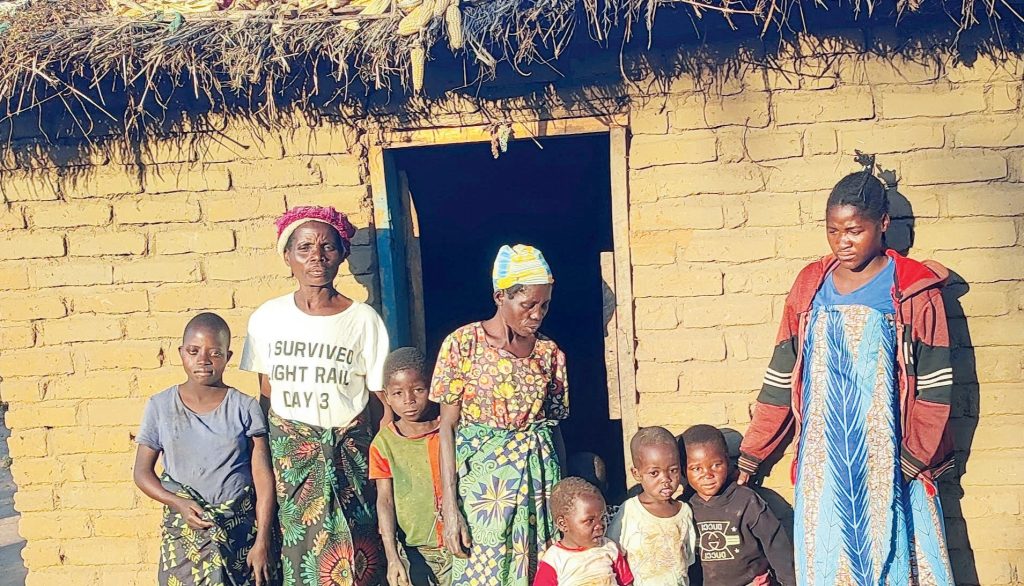
During yesterday’s visit to Kasungu, we found three women sitting under a small house in Chafwamba Village, their children seated nearby.
According to Magdalena Banda, Salome Phiri, and Yeverestia Nkhoma—once prosperous farmers who harvested dozens of bags of maize and soya annually—none of them had eaten a proper meal in two days.
Today, they share a cramped piece of land allocated by the chief, surviving on piecework and hope. “We are all widows and hungry,” Nkhoma said.
“I remember before being displaced, food was plentiful. I could harvest more than 50 bags, which was enough for my household and for sale. But now, we are eating madeya (maize bran) like pigs. That is how bad things have become,” said Nkhoma, the mother of six who now also cares for her grandchildren.
Magdalena Banda’s story
In Chifwamba Village, the plight of the three mirrors that of dozens of others. Before losing her land, she annually harvested over 10 bags of maize and soya. Following her husband’s death, she is left caring for three grandchildren under the age of five with zero means of income.
“To find food this year, I did piecework in other people’s gardens and was paid K10 000,” Banda explains. “That was enough to buy one pail of maize and some soap. But the harvest is finished, and there are no more piecework opportunities. Without a home and land to cultivate, it is hell.”
Widespread Destitution
Other women in the community are facing identical hardships. Salome Phiri, a mother of five who also cares for a grandchild, lost her land and attempted to farm in a dambo area.
“Everything was washed away by heavy flooding,” Phiri says.
“Just like my fellow women, I relied on piecework to survive, but that source of income has dried up. There is literally no food in this house.”
Kanoki Phiri, 43, is among those grieving the loss of a family member. His wife was trampled to death by an elephant in 2023, leaving him to care for five children, the youngest just a few months old. That year, national park officials provided the children with uniforms, books, and pencils—the only assistance Phiri says he has ever received.
“If I kill an animal in the park, I face severe arrest and heavy fines,” Phiri said. “Yet, elephants have killed several people and destroyed our crops and houses, and nothing is done. They brought the elephants in before erecting a fence. Why? It is as if they disregarded our humanity and decided it was okay for these animals to live among us.”
Phiri struggles to find casual labour because he cannot travel far from home; his children need him there. “As a father, I feel like I am failing,” he said. “I am expected to provide food, soap, and school fees, but how can I? I cannot leave my children. Life is incredibly tough.”
Families sue for K3 billion
Desperate for resolution, the affected families have turned to the courts. According to a letter from Clarkes Attorneys, the families and their ancestors have continuously lived on and farmed this land since 1933—predating the official establishment of Kasungu National Park.
The letter outlines that when the park was gazetted in 1970, a boundary was demarcated using a public road, and a wire fence was erected along it to separate the park from the community’s farmland.
“The families and their ancestors have continuously lived and farmed on the land in question since 1933—a period exceeding 90 years,” the letter reads.
“Their presence and agricultural use predate the establishment of Kasungu National Park. Having lost their entire means of livelihood, the families are now destitute, hungry, and living like refugees in their own country. They are displaced from their homes and farmlands, with no access to food, shelter, or income.”
Lawyers representing affected families have formally accused the Department of National Parks and Wildlife of unlawful trespass and severe constitutional violations. Their legal notice alleges that officials infringed upon residents’ rights to property, fair administrative action, livelihood, food, and dignity.
The letter further claims that authorities used “force, intimidation, and threats” during engagements with local families and ignored existing land registration documents.
This dispute stems from a boundary tracing exercise. In 2024, then-Minister of Tourism Vera Kamtukule stated that the initiative identified roughly 8.5 kilometres of encroached territory around Chulu.
She maintained that most affected households had their homes situated outside the protected area and that the government was strictly adhering to gazetted boundaries.
However, the affected residents are demanding immediate relocation of the wildlife fence to its original boundary along a road established in 1970. They are also seeking K3 billion in compensation for lost land, destroyed crops, and emotional distress, alongside urgent humanitarian relief—such as food aid, seeds, and temporary shelter.
Govt given 90-day ultimatum
The lawyers have given the government 90 days to respond to the ultimatum, which expires in August 2026. The legal notice concludes with a stern warning: “Should the Attorney General and the Ministry of Natural Resources fail to respond to this letter within 90 days from the date of receipt, or fail to take concrete steps to comply with the demands above, we shall have no option but to commence legal proceedings in the High Court.
“We trust that the government of Malawi, through your office, will act swiftly to remedy this grave injustice.”
Chulu Planning for the Future director Charles Bainett strongly criticised the tracing exercise, framing it as a blatant violation of citizens’ rights.
“The authorities have deliberately encroached onto people’s shelters and gardens. Our efforts to intervene have yielded nothing,” Bainett stated in an interview.
“At first, the people were informed that only 10 metres would be taken, but to everybody’s surprise, 300 metres have been encroached upon.”